Guide for Authors
XSci · September 2026
Everything you need to know to post work, buy a review, and understand what you get. Terms in bold on first use are defined at the end.
The path at a glance
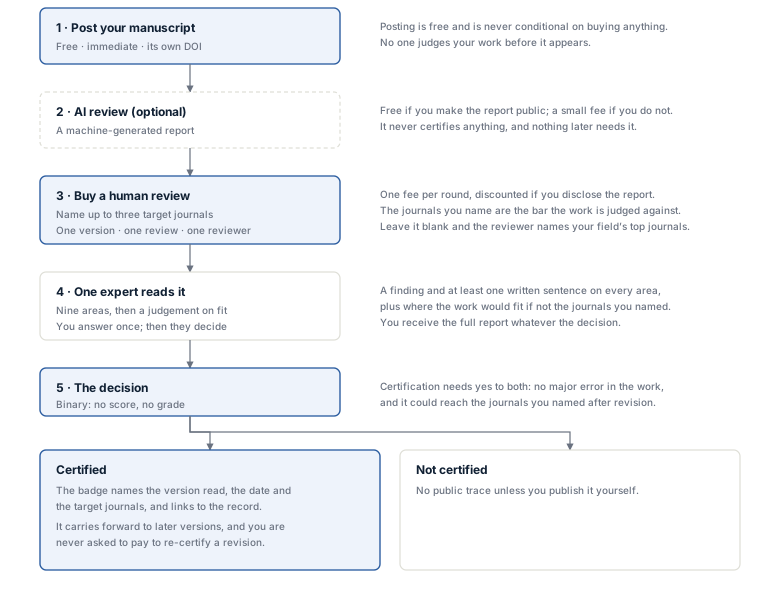
The whole path. Everything after step 1 is optional, and stopping at step 1 costs nothing and is permanent. Dashed borders mark an optional purchase. Every round costs the same whatever the decision and whatever the round number; what a round costs at all depends on whether you choose to disclose the report, and a report bought at the discounted, disclosed price is published automatically 48 hours after the report is released to you. A successful appeal is refunded. It is not a re-review and not a route to certification.
1. Posting is free, and always will be
You post a manuscript. It is published immediately, with its own permanent identifier (a DOI), a licence you choose, and full indexing. It is free to read and free to post, with no limit on how many you send.
No one judges your work before it appears. There is no editorial gatekeeping, no quality gate, and nothing you buy affects whether your manuscript appears or gets its DOI. Concerns raised about a published preprint are handled afterwards, through the published concerns process, against a document that already has a DOI.
No purchase is ever required. Everything after posting is optional, and you can stop after posting permanently at no cost. Buying a review later changes nothing about the posting itself.
Every posting is an XSci Preprint. That label says the work is published here. It says nothing about quality, because nothing was assessed.
2. The two things you can buy
| XSci AI review | A machine-generated report on your manuscript | Free if you make the report public; a small fee if you keep it private |
| XSci human review | One expert in your field reads your manuscript in depth and decides whether to certify it | One fee per round, the same for every round, and lower if you choose to make the report public |
An AI review never certifies anything. It produces a readable report and, if you choose, an AI-reviewed marker on your preprint. The marker means a report exists, not that it was favourable. Nothing later requires you to have bought one.
Human review is available on posted preprints only. If you choose the private-analysis track instead of publishing (section 8), AI review is the only thing on offer.
Current prices are on the pricing page, and they are the same for everyone. There is no negotiated rate.
Two things are true here at once, and they are about different things.
- Every round costs the same. The fee does not depend on the decision, on whether this is your first round or your fourth, or on anything you can add to it. There is no cheaper rate for a revision, no premium option, and no extras. In particular, you cannot buy a second opinion on the same version at any price (see section 6).
- What a round costs at all depends on one choice you make at purchase: whether the report will be public. There are two prices, you choose between them when you buy, and the public price is the lower of the two. It is a discount for disclosing the report rather than a surcharge for keeping it private, and every round is charged at whichever of the two prices you chose, first round or fourth.
If you buy at the discounted, disclosed price, the report is published automatically, 48 hours after the report is released to you, not 48 hours after you pay. The clock starts when you receive the report, so you always see it before anyone else does, and you have two days with it before it goes public. You do not have to do anything, and there is no confirmation step. So choose the disclosed price only if you want the report public whatever it says. Section 9 sets out what it costs to change your mind afterwards.
3. What certification means
If your manuscript is certified it carries the label XSci Peer-Certified Preprint, and that label says exactly this:
A qualified independent expert read this version and judged that, after revision of the kind a journal would normally ask for, it has the potential to be published in the target journals you named, and that it contains no major error.
It is not an acceptance, and no journal is bound by it. It does not say your findings are true, or that they would come out the same way if someone gathered new data. It is one expert's honest opinion on the manuscript in front of them, and another expert might have judged differently.
There is no score and no grade. A manuscript is certified, or it is a preprint. Nothing is ranked.
4. Naming your target journals, which matters more than anything else you decide
When you buy a human review you may name up to three journals you are aiming at. This is optional but strongly recommended, and it is worth understanding why.
The target is the bar. The reviewer is not asking whether your work is good in the abstract; they are asking whether it is at the level those journals publish. A list counts as a tier, so potential for any one of the three is enough.
Aim honestly. Name a journal your work does not reach and you will not be certified, even if the work is entirely sound. Name one well below where your work belongs and you will get a mark that says exactly what it was measured against, since the target appears on the record. Neither is a disaster, but the sensible strategy is simply to name the journals you genuinely believe in.
Leaving it blank is a real option, not a gap. If you name nothing, the target becomes the top journals in your field. The reviewer decides what those are, judges against them, and must name in the report which journals they had in mind. Many authors genuinely do not know where their work belongs, and for them this is the most useful thing in the report. It is a broad and demanding bar, so leave it blank because you want the reviewer's view, not to avoid the question.
You can name a different target next time. What a manuscript was certified against never changes.
5. What you get, whatever the decision
A written report from the reviewer. It has two parts, and you get both in full whether or not you are certified.
The assessment. A finding and at least one written sentence on each of nine areas your manuscript engages: the question and design; the methods; the data and materials behind the work; the analysis; the results and reporting; the claims and conclusions; how far the reviewer could get in checking the material your claims rest on; whether the sources carrying your central claims say what you say they say; and whether funding, competing interests, AI use and registration are declared. Where an area does not apply to your kind of work it is marked not applicable, which is never a mark against you.
The judgement on fit. The target journals, whether your manuscript has the potential to reach any one of them, why, and, whenever the answer is no, which journals the reviewer would actually recommend instead, together with what you would need to change to be credible at the level you named.
That last part is the reason a refusal is still worth having. A manuscript aimed at a top journal that a reviewer thinks belongs in a strong specialist one comes back as a refusal and a recommendation, in the same breath.
6. How a review runs, and your one response
- You buy a review of one version and name your target journals, or leave them to the default.
- One reviewer is matched to your work. One version gets one paid review, by one reviewer.
- The reviewer records the decision, on the version you gave them.
- The report is checked by XSci for completeness, never for its conclusion, and released to you together with the decision.
- You have one response. It is recorded on the record beside the report. It is commentary: it does not change the decision or the report, and the reviewer does not read your work again.
- To have a revised version assessed, deposit it (free, dated, its own DOI) and buy an assessment of that version at the ordinary assessment fee.
There is no revision inside an assessment. No one at XSci can ask a reviewer to change a decision, and no one has the authority to.
7. If you are not certified
Two routes, and you can take either.
Revise and come back. Post a new version and buy another round at the same fee. This is what the service is for. Improving a manuscript until it is of publishable standard is the outcome XSci exists to produce, and coming back with revised work is treated as exactly that.
Appeal. Free, on four grounds: the Certification Procedure was not followed; the reviewer had an interest that should have barred them; the report contains an error of fact about your manuscript; or the report falls below the standard of detail and quality the Certification Procedure requires, meaning areas not properly addressed, sentences that say nothing specific about your work, or a placement judgement given without reasoning.
Grounds one and four are measured against the Certification Procedure, the published document that sets out step by step how an assessment is carried out. It is free to read, and worth reading before you appeal on either of those grounds.
Disagreeing with the conclusion is not a ground. That the reviewer weighed your evidence differently, or placed your work at a different level than you would, cannot be appealed. That they gave no reasoning for where they placed it can.
If your appeal succeeds, we refund the assessment fee in full. That is the whole of the remedy, whatever the ground. There is no further review, no replacement reviewer and no second judgement: the report stands as written, the record stands as it is, and you have your money back.
So an appeal is not a route to certification. An appeal that succeeds means you paid for something we did not deliver properly and have been repaid. It does not change the decision. What it leaves you free to do is buy another round on a new version, on exactly the terms anyone else would get. Where an appeal does not succeed, nothing is charged for having made it.
A refusal is not refunded for being a refusal. The assessment fee, what you pay us for an assessment, buys the assessment and not the certificate. A refusal is a complete piece of work, and the report is the thing you paid for. There are exactly two grounds on which money comes back: we failed to deliver, or your appeal succeeded. Disagreeing with the outcome is neither.
8. The private-analysis track
Instead of publishing, you can upload a manuscript for private analysis. AI review only, at the same fee as a private-report AI review on the preprint track. There is no DOI, it is not citable, no human review is available, and the choice cannot be reversed afterwards. Use it if you want a machine read on work you are not ready to post.
9. What is public, and what you control
You decide whether any report is published, AI or human, certified or refused.
- A certification is public, because displaying the mark is your own choice. The record behind the mark is published with it.
- A refusal leaves no public trace unless you publish it. XSci does not publish it, and does not say whether your manuscript has been assessed at all.
- If you do publish a refusal, it costs nothing, it is clearly marked as a refusal, it carries no mark, it includes the reviewer's recommendation of where your work would fit, and you may publish your own reply beside it.
A report bought at the disclosed price is published automatically, 48 hours after the report is released to you. The clock starts when you receive it, not when you pay, so you see the report first. You do nothing, and there is no confirmation step.
Opening a report is always free. Closing one costs the difference. You can make a private report public at any time at no charge, and nothing is refunded, because the fee stays as it was. If you bought at the disclosed price and later move the report to private, you pay the difference between the two prices, because the lower price was a discount for disclosing and withdrawing the disclosure withdraws the discount. Two things about that charge:
- It is charged once only. Withdraw, restore, withdraw again, and you owe nothing further.
- It is worked out at the prices in force on the day you bought the round, never at a later price. If prices change afterwards, that does not reach back into a round you have already paid for.
What XSci publishes about itself. We will endeavour to publish, at least annually and free of charge: how many assessments were completed, what proportion were certified with the denominator stated, and how many certifications came on a first round, a second and a third. These figures come from our own records and no reader can audit them, and we say so. Nothing about an individual reviewer is ever published.
10. Versions, and how long a certification lasts
The mark carries forward. When you post a later version, your certification stands. It is not revoked, and you are never asked to pay to re-certify a revision. Revising is what authors are asked to do, and a mark that punished you for it would be working against its own purpose.
When a certification can be revoked. Revoked is the word we use when a certification is taken off the record, and it happens on one basis only: a finding that the record was materially false, either that the work was not as the record described it, or that the record did not disclose an interest that barred the reviewer who made it. Never because a reviewer changed their mind, because a later study disagreed, or because your manuscript became controversial. A revoked certification is never deleted: the record stays, marked as revoked, with the date and a reason.
Where the fault was ours, you are refunded. An undisclosed barring interest is a failure of our process and says nothing about you or your work. So the certification is revoked and your assessment fee is refunded in full. We issue it, and you do not have to ask. You can appeal a revocation, free, and it is decided against the COPE, ICMJE and Crossref standards named in our Retraction and Correction Policy; the remedy there is that the revocation is set aside and the certification restored, or that it stands. No refund arises from that appeal, because where one was owed it has already been paid.
The record permanently names the version that was read, the date, the target journals, and the version of the Standard in force. When you post a new version you say whether it is a minor or a substantial revision of the certified one, and where it is substantial the page says so beside the mark. For example: "Certified at version 2 on 3 March 2027. Version 4 is the current version and is a substantial revision of the version certified." No claim is ever made that a later version was read.
You can buy an assessment of a later version at any time, at the same fee as any other. There is no expiry.
11. Who reviews your work
For each manuscript XSci invites experts from three groups: authors of work you cite, close collaborators of those authors, and researchers who have published on similar questions in the journals you are aiming at. That last group is preferred, because they are best placed to judge fit. So you know, before anything begins, what kind of reader your paper will meet.
Four things require a reviewer to decline outright: a prior role in your work; a close personal relationship or a dispute with an author; a financial or commercial interest in the outcome or subject matter; or a current supervisory relationship with an author. Anything else, including recent co-authorship, shared affiliation, competing work or a rivalry, is declared to XSci, which decides whether to proceed, and the declaration goes on the record.
Reviewers are paid the same whatever they decide, and take no credit on your manuscript. There is no contact between you and the reviewer in either direction; everything goes through the report.
12. What you cannot buy
Faster handling of a judgement. A different reviewer because you dislike the first one's conclusion. A second opinion on the same version, by appeal or by any other route. A tie-break. Preferential treatment of any kind. Removal of a certification record. Your money buys an assessment and nothing else.
Terms used here
DOI. A permanent identifier for one version of a document. It keeps working, and it is what other people cite.
Major error. A defect which, while it stands, means your central claims are wrong, unsupported or impossible to evaluate, as distinct from something you could reasonably be asked to put right. Anything ordinary revision would address is not one. Six things prevent certification outright: required ethics, consent or regulatory approvals absent or inconsistent with the work; methods too incompletely described for the analysis to be evaluated; reported quantities irreconcilable with the design or sample; central claims unsupported by the evidence; undisclosed competing interests material to the findings; and plagiarism, undisclosed duplicate publication or unexplained signs of image or data manipulation. The first four you can fix. The last two are integrity matters, handled separately.
Record. The permanent statement of a completed assessment: the version, the date, the target journals, the decision and its reasons, the reviewer's findings and sentences, their judgement on fit, their competing-interest declaration and their use of AI. Whether it is published is your decision.
Round. One paid review of one version. Exactly one per version. Every round costs the same, whatever the decision and whatever the round number; which of the two prices applies is the disclosure choice you make at purchase (section 2).
Target journals. What you are aiming at, recorded when you buy: up to three named journals, or a blank that resolves to the top journals of your field. See section 4.
Underlying materials. Whatever your claims rest on, and which another competent person would need to check them. Entirely field-dependent: measurements, data, code, transcripts, field notes, source texts, images, instrument or archival records, derivations and proofs, protocols, specimens. No kind is treated as better evidence than another, and a manuscript with no data and no code is not less verifiable for it.
Version. One posting of a manuscript, with its own DOI. Each revision is a new version.
The full Certification Standard sets out the rules in detail, and the Reviewer Questionnaire is the form your reviewer completes. Both are published.