Guide for Reviewers
XSci · September 2026
What you are being asked to do, what you are paid, and what we will and will not ask of you. Terms in bold on first use are defined at the end.
Four things to know before you accept anything
| Your payment does not depend on your conclusion. | You are paid the same for certifying and for refusing, and nothing in your reviewer payment turns on the outcome. A refusal is a complete, delivered assessment, not a failure. |
| You assess against a published standard, not your own threshold. | That standard has two limbs: no major error, and whether the work is at the level the target journals publish. Both are yours to judge. |
| You decide on the version in front of you. | You decide on the version as presented, and on nothing after it. The author's one response comes after your decision, is recorded on the record as commentary, and never returns to you. "Revise and I will judge then" is not an available answer. |
| You are anonymous. | Your identity is not disclosed to the author, and nothing XSci publishes identifies you. The author never contacts you and you never contact them. |
The path at a glance
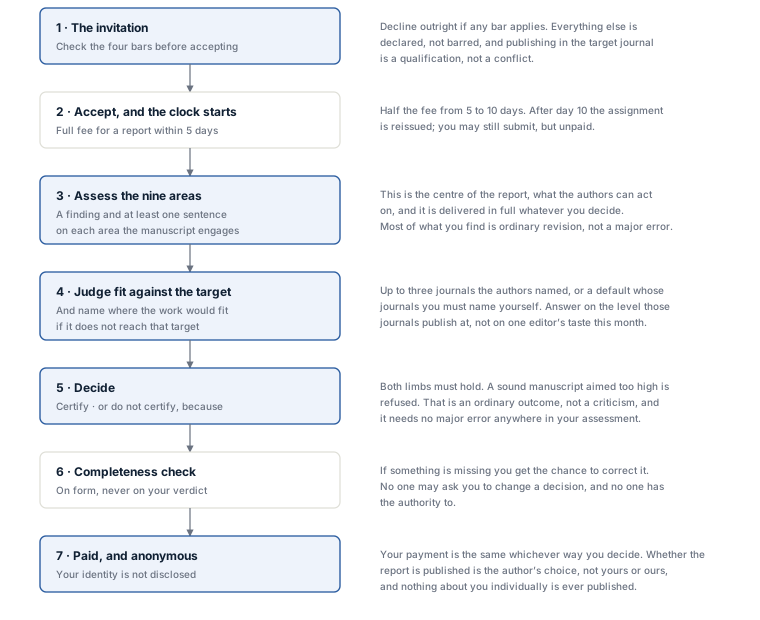
The whole path, from invitation to payment. A version is read once, by one reviewer. No second reviewer ever joins: authors cannot buy a second opinion at any price, and where an appeal about the quality of a report succeeds the author is refunded, while your report and your reviewer payment are untouched.
1. The two questions you answer
Certification needs yes to both.
Is there a major error? Does what was done support what is claimed? Nearly every manuscript that reaches a journal needs work, so the real question is whether what it needs is revision or reconstruction. Anything the authors could reasonably be asked to fix is ordinary feedback and does not stand in the way. A major error does: the design cannot support the claims, the methods cannot be evaluated at all, the numbers cannot be reconciled with the study described, or the central claims cannot be brought within the evidence by revising.
Could it reach the target? Assuming that revision were done competently, would this manuscript have a genuine prospect of publication in the journals the authors named? This is a judgement about the level of the contribution, and it is what your expertise is being paid for.
The two are independent. A manuscript can be entirely sound and still not be certified because it was aimed higher than it reaches. That is a normal outcome, not a criticism of the work. You say so, and you say where it would fit instead. A refusal with no major error anywhere is a perfectly ordinary report.
2. The target journals
The authors may name up to three, and naming is optional, so you will see one of two things.
Journals they named. Judge against those. Potential for any one of them is enough.
The default, the top journals in this field. They named none. You decide what counts as a top journal here, using the same judgement you would apply to a named one, and you must name in your report which journals you had in mind. A default target left unnamed is not an acceptable answer: the authors cannot act on "the top journals in your field", and a reader cannot tell what the mark was measured against.
Three rules:
- Answer on the tier, not on one editor's taste this month. You are not predicting an editorial decision. You are judging whether the contribution is of that level.
- If you cannot place the work, say so. A list too wide, too unfamiliar or too poorly matched to the work, or a default you cannot identify confidently, means you cannot form the judgement. That is a refusal with that stated as the reason. It is never a reason to certify by default.
- Never make certification conditional on the authors renaming their target. You may not offer to reconsider if they aim lower. The target was fixed when the assessment was bought.
3. Before you accept
Decline outright if any of these applies. Each is a bar, and disclosing it does not cure it:
- A prior role in this work. You advised on it, reviewed it for a journal, or took part in producing or correcting any part of it.
- A close personal relationship, or a dispute, with any author, of a kind a reasonable person would think material.
- A financial or commercial interest in the outcome, or in the subject matter to the extent the outcome would affect it.
- A current supervisory relationship with any author, in either direction.
One exception: if you reviewed an earlier, certified version of the same manuscript, the prior-role bar does not apply to you for a later version.
Everything else is declared, not barred. Recent co-authorship, shared affiliation, competing work in the same area, a rivalry, a strong prior public position on the question: you declare it, we decide whether to proceed, and the declaration goes on the record. This follows ICMJE and major-publisher practice. Having published in the target journal is a qualification, not a conflict. It is why we sought you.
If you discover a bar partway through, stop and tell us. There is no consequence for doing so, at any point.
If the manuscript engages an area you cannot judge, tell us before you start. We will change or add a reviewer. Do not mark such an area not applicable, which is for what the manuscript does not do, never for what you cannot assess.
4. What you write
Two required parts.
The assessment. For each of nine areas the manuscript engages: one finding, and at least one sentence saying what you looked at and what you found. The areas are the question and design; the methods; the data and materials; the analysis; the results and reporting; the claims and conclusions; verifiability; prior work and the sources carrying the central claims; and transparency of funding, interests, AI use and registration.
The four findings available are no concern; concern noted, not material; major error; and not applicable, with a reason. Most of what you find belongs in the second. Nothing is counted. The findings are never added up, averaged, scored or ranked, by us or by anyone downstream. They exist so every area gets deliberate attention.
This part is the centre of the report. It is what the authors can act on, and it is delivered in full whatever you decide. Do not cut it short because you have already formed a view on fit.
The judgement on fit. The target as named, or the journals you identified for a default; whether the work has the potential to reach any one of them; why; and where it would fit, required whenever the answer is no, and welcome when it is yes, together with what the authors would need to change to be credible at the level they named.
On verifiability, record how far you actually got and no further: that the underlying materials are declared; that they are reachable and as described; or that the reported results follow from them. How you reach that last step depends on the work. You might re-run code where any is provided, recompute figures from data, follow a derivation, trace quoted material back to its source, or check values against records. No kind of work is privileged: a manuscript with no data and no code is not less verifiable for it. Where materials were not provided, say what was missing. Absence is recorded as absence, not as a fault. Whether findings would hold up on new data is never assessed and never implied. Do not comment on it.
5. Two things that are not your question, and two that now are
Not yours. Whether the findings are true. Whether they would come out the same way from new data. Writing quality beyond what is needed to evaluate the work. Who the authors are, where they work, or who funded them.
Yours. The level and reach of the contribution, relative to the target journals. And a recommendation of where the work would fit. If you have reviewed for XSci before, note that this has changed: an earlier version of this guide told you not to comment on journal suitability. It is now half the decision.
6. The decision
Certify, meaning no major error remains in any applicable area and the work could reach the target. Do not certify, because, with each reason stated specifically, anchored to the place in the manuscript for a major error, and stated against the target for a question of fit. Say which kind each reason is: one tells an author this needs fixing, the other this is not the right home for it.
You cannot ask for revisions as a decision, make certification conditional on a further purchase, or contact the author.
Your decision stands alone. One version is read by one reviewer, and that reviewer is you. No second opinion moderates yours, no panel averages it, and nobody can overturn it on the merits.
No second reviewer ever joins. Authors cannot buy a second opinion at any price, and there is no other route to one. Your judgement is never joined by another, never averaged and never revisited. This holds whatever happens on appeal: where an appeal succeeds the author is refunded, and the version is not read again.
One thing may change in future, and we would rather tell you now than surprise you later: a re-assessment of the same version by a different reviewer, where an appeal has succeeded, is a remedy XSci may be able to offer at some point. It does not exist today and we cannot process one. If it is ever introduced it will be by a published change to the Certification Standard and the Certification Procedure, it will apply only to assessments bought afterwards, and it would still take nothing away from your report or your payment.
What an appeal does. Authors may appeal on four grounds, all of them about the conduct and quality of an assessment rather than its conclusion: that the Certification Procedure was not followed; that the reviewer held an interest that barred them; that the report contains an error of fact about the manuscript; or that the report falls below the standard of detail and quality the Certification Procedure requires. Where an appeal succeeds, the author is refunded the assessment fee, and that is the whole of the remedy. There is no re-review, no replacement reviewer, and no change to the decision. Your report stands on the record as you wrote it and your decision is not changed. We write this as the appeal succeeds or does not succeed.
A successful appeal does reach your payment, and we would rather you knew that plainly. Each of the four grounds is a finding that the assessment was not delivered as it had to be, so where an appeal succeeds the payment for that assessment is not due, and is recovered if it has already been paid. Nothing about this turns on what you decided. A refusal delivered in full is a completed, payable assessment, and a decision XSci disagrees with is never a ground for withholding payment. You are told the ground and you may answer it first, with no limit on the exchanges. A question of fact is often resolved that way rather than decided, and where it is resolved the appeal does not succeed and your payment stands. Where it cannot be resolved, XSci adjudicates and may take an independent expert view before it does. The full terms are in the Reviewer Agreement.
The Certification Procedure is the document two of those grounds are measured against. It is published, free to read, and sets out step by step how an assessment is carried out: the assignment, the two questions, the areas, the decision, the completeness check and the author response. Reading it is the surest way to be sure a report of yours could not succeed on ground one or ground four.
The one case that touches your report after release. Where an appeal succeeds on the ground that a reviewer held an interest that barred them, the certification is revoked and the author is refunded. That is a consequence for the record, not a judgement on the contents of your report, and nothing about you individually is published, then or at any time. The version is still not read again.
An appeal is never available against your conclusion, only against the quality of your report. A sentence on every area and your reasoning on fit are what put your judgement beyond challenge.
7. Integrity matters: refer, do not judge
If you see signs of undisclosed competing interests material to the findings, or of plagiarism, undisclosed duplicate publication, or image or data manipulation the authors do not explain: refer it to us and stop.
You do not decide it, you do not weigh it as a concern in your assessment, and you must not write it into the report, because the report may be published and an allegation must not be. Use the referral field, state what you observed and where, facts only and no conclusion about intent. While a referral is open the assessment shows as in progress with no public reason. These matters are handled separately, with protections for everyone involved.
8. Payment, timing and your identity
You are paid on delivery, at the published minimum rate or above. The rate is public, it does not vary by country, and it cannot be reduced for you individually.
Payment tapers with delivery date: full payment for a report delivered within 5 days of accepting, half from 5 to 10 days, and after day 10 the assignment is reissued to someone else, so you may still complete it, but unpaid. This exists because an author who has paid for turnaround is badly served by a reviewer who has taken the work and gone quiet.
Your report is checked for completeness before the author sees it, on form, never on your verdict. Whether every area carries a finding and a sentence, whether your reasons are specific, whether your judgement on fit is present and reasoned, whether you named the journals for a default target, and whether anything in it belongs in an integrity referral instead. If something is missing you get the chance to correct it. No one may ask you to change a decision, and no one has the authority to.
Your identity is not disclosed to the author, and nothing XSci publishes identifies you. Whether your report is published is the author's decision, not yours and not ours to veto, and if they refuse to publish a refusal, it leaves no public trace at all.
The author holds the final right over that decision, and may change it. A report bought privately can be opened later, and a published one can be taken private again; the election is the author's throughout and is not fixed at purchase. So write every report on the footing that it may be read publicly, which is what Section 7 means when it says an allegation must never go in the report.
Nothing about you individually is ever published or sold: not your turnaround, not your certification rate, not anything. XSci will endeavour to publish aggregate figures about the service at least annually; nothing in them is per-reviewer.
You take no credit on the manuscript. Assessing is paid work, and never authorship, contributorship or acknowledgement. If you would want credit for the contribution you are about to make, you are not assessing the manuscript and should decline.
9. Situations that come up
| The manuscript is sound but aimed too high | Refuse, and recommend where it fits. This is the ordinary shape of a fit-only refusal and needs no major error anywhere. |
| You cannot judge the target | Say so. It is a refusal with that as the reason, never a default certification. |
| You think the target is too low | Say so in your report as advice. Certify if it clears the bar they named; you may not require them to aim higher. |
| The authors revise after your report | Where you certified, the mark carries forward and no fresh round is needed. Where you refused, they may revise, post a new version and buy another assessment at the same assessment fee. That is the process working. |
| You realise mid-assessment that you have a conflict | Stop and tell us. Found honestly, it costs you nothing. |
| You are asked for a second opinion on a version someone else read | We do not offer this and cannot process it. A version is read once, by one reviewer, and no route reopens it: a successful appeal is refunded, not re-reviewed. Any such request is not from us. |
| You want to add something after release | Say it as a dated addition to the record. Your original finding stands as it was; judgements are never rewritten. |
Terms used here
Certification. The public statement that a qualified independent expert judged this version to have the potential, after revision of the kind a journal would normally ask for, to be published in the target journals, and to contain no major error. Binary: a manuscript is a certified preprint, or it is a preprint. No score, grade or ranking exists.
Major error. A defect which, while it stands, means the central claims are wrong, unsupported or impossible to evaluate, as distinct from something the authors could reasonably be asked to put right. Six things prevent certification outright: approvals absent or inconsistent with the work; methods too incompletely described to evaluate the analysis; quantities irreconcilable with the design or sample; central claims unsupported; and the two integrity matters in section 7.
Preprint. A manuscript the authors have posted publicly, with its own permanent identifier, before or without journal publication. Posting on XSci is never conditional on buying anything, and no one judges the work before it appears.
Record. The permanent statement of a completed assessment: the version, the date, the target journals, the decision and reasons, your findings and sentences, your judgement on fit, your competing-interest declaration, whether you worked blind, and your own use of AI. Whether it is published is the author's decision.
Round. One paid assessment of one version, which is what you are engaged for. Exactly one per version. What the author pays does not vary with your decision or with the round number; nothing about the fee reaches your compensation, which is the published rate whichever way you decide.
Target journals. What the authors are aiming at, recorded when they bought the assessment: up to three named journals, or a blank that resolves to the top journals of the field, which you identify and must name. See section 2.
Underlying materials. Whatever the manuscript's claims rest on, and which another competent person would need to check them. Entirely field-dependent: measurements, data, code, transcripts, field notes, source texts, images, instrument or archival records, derivations and proofs, protocols, specimens. No kind is treated as better evidence than another.
Version. One posting of a manuscript, with its own identifier. A certification names the version you read; the mark stays on later versions, and where a later version is a substantial revision the page says so beside it.
The Certification Standard sets out the rules in full, and the Reviewer Questionnaire is the form you complete. Both are published.